


In the manner of Mayhew & Ince
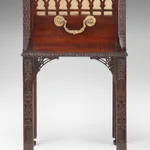
George III mahogany wine cistern , circa 1760
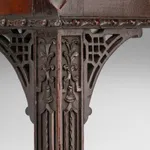
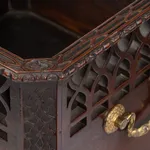
with blind fretwork-carved decoration on top edge and canted corners and arch-shaped piercings above further blind fretwork-carved decoration to the legs raised on replaced leather castors with later brass liner; with original gilt brass carrying handles
53.3 x 33 x 32.4 cm
21 x 13 x 12 ¾ in
21 x 13 x 12 ¾ in
7213
Further images
-
(View a larger image of thumbnail 1
)

-
(View a larger image of thumbnail 2
)

-
(View a larger image of thumbnail 3
)

-
(View a larger image of thumbnail 4
)
-
(View a larger image of thumbnail 5
)

-
(View a larger image of thumbnail 6
)
-
(View a larger image of thumbnail 7
)

-
(View a larger image of thumbnail 8
)
Provenance
Possibly supplied to George Weller-Poley Esq., Boxted Hall, SuffolkCollection of Louis Colville Gray Clarke FSA (1881-1960), Director of The Fitzwilliam Museum, Cambridge University (1937-46)
Thence by descent
This small square wine cistern appears to be part of a larger suite of furniture with identical blind fretwork comprising at least sixteen dining-chairs, two pairs of stools and a...
This small square wine cistern appears to be part of a larger suite of furniture with identical blind fretwork comprising at least sixteen dining-chairs, two pairs of stools and a pair of card tables - which were almost certainly supplied for George Weller-Poley for Boxted Hall, Bury St. Edmunds in Suffolk in about 1760. George Weller-Poley, the only son of Elizabeth Poley of Boxted Hall and Robert Weller of Tunbridge in Kent, inherited the estate in 1751 at the age of 41.
A pair of the stools were sold at Christie's New York as part of the collection of WIlliam F. Reilly on 14th October 2009. According to the catalogue entry, Weller-Poley Family tradition held that the suite had been at Boxted Hall for many generations. Sadly, there are no family papers or inventories of the period to provide any details or shed light on a possible maker, although the quality of timber and carving supports an attribution to a leading shop. The 'Chinese' fretwork on the legs takes inspiration from patterns published by Thomas Chippendale, Mayhew and Ince and Robert Manwaring.
The fretwork's most unusual feature is the bell-design incorporated into the fretwork pattern. Manwaring's The Cabinet and Chair-Maker's Real Friend and Companion (1765), plate IV illustrates a design for a 'parlour' chair with a square leg headed by a bell; additionally, the splat and top-rail are designed in the same tradition the Weller-Poley chairs. Plate XII shows designs for two 'Chinese Chairs', one of which has Chinese fret carved legs with bells. These are the only known chair designs of the period with bells on the legs. No documented pieces of furniture by Manwaring are recorded, whether chairs or anything else, although he claimed that his designs 'are actually Originals, and not pirated or copied', adding 'there are very few designs advanced, but what he has either executed himself, or seem completely finished by others'. Manwaring also designed a rectangular stool with a Chinese fret leg which can be compared with the Weller-Poley examples.
In 1762, Mayhew and Ince published their Universal System of Household Furniture which includes a plate showing designs for card-tables, one of which is carved with variations of Chinoiserie fret ornament (pl. LII). Tables featuring the same fretwork design and almost certainly from the same workshop include: a side table illustrated in G. Beard and J. Goodison, English Furniture 1500-1840, London, 1987, p. 135, fig. 5; a pair of serpentine card tables sold Christie's, New York, 12 April 1996, lot 169; another serpentine card table from Earl Howe's collection at Gopsall Hall, Leicestershire illustrated in M. Harris & Son, Antique Furniture and Works of Art, London, n.d. (c. 1930), p. 49).
A pair of the stools were sold at Christie's New York as part of the collection of WIlliam F. Reilly on 14th October 2009. According to the catalogue entry, Weller-Poley Family tradition held that the suite had been at Boxted Hall for many generations. Sadly, there are no family papers or inventories of the period to provide any details or shed light on a possible maker, although the quality of timber and carving supports an attribution to a leading shop. The 'Chinese' fretwork on the legs takes inspiration from patterns published by Thomas Chippendale, Mayhew and Ince and Robert Manwaring.
The fretwork's most unusual feature is the bell-design incorporated into the fretwork pattern. Manwaring's The Cabinet and Chair-Maker's Real Friend and Companion (1765), plate IV illustrates a design for a 'parlour' chair with a square leg headed by a bell; additionally, the splat and top-rail are designed in the same tradition the Weller-Poley chairs. Plate XII shows designs for two 'Chinese Chairs', one of which has Chinese fret carved legs with bells. These are the only known chair designs of the period with bells on the legs. No documented pieces of furniture by Manwaring are recorded, whether chairs or anything else, although he claimed that his designs 'are actually Originals, and not pirated or copied', adding 'there are very few designs advanced, but what he has either executed himself, or seem completely finished by others'. Manwaring also designed a rectangular stool with a Chinese fret leg which can be compared with the Weller-Poley examples.
In 1762, Mayhew and Ince published their Universal System of Household Furniture which includes a plate showing designs for card-tables, one of which is carved with variations of Chinoiserie fret ornament (pl. LII). Tables featuring the same fretwork design and almost certainly from the same workshop include: a side table illustrated in G. Beard and J. Goodison, English Furniture 1500-1840, London, 1987, p. 135, fig. 5; a pair of serpentine card tables sold Christie's, New York, 12 April 1996, lot 169; another serpentine card table from Earl Howe's collection at Gopsall Hall, Leicestershire illustrated in M. Harris & Son, Antique Furniture and Works of Art, London, n.d. (c. 1930), p. 49).