


Japanese Export Lacquer Inlaid Nanban Table Cabinet, Between 1568-1600
JAPAN, MOMOYAMA PERIOD (1568-1600)
Lacquered wood with gilt decoration, mother of pearl inlay and gilt brass metalwork, with restorations
31.5 x 43 x 30.5 cm
12 ½ x 17 x 12 in
12 ½ x 17 x 12 in
7126
Further images
-
(View a larger image of thumbnail 1
)

-
(View a larger image of thumbnail 2
)

-
(View a larger image of thumbnail 3
)
-
(View a larger image of thumbnail 4
)
-
(View a larger image of thumbnail 5
)

-
(View a larger image of thumbnail 6
)

-
(View a larger image of thumbnail 7
)

-
(View a larger image of thumbnail 8
)

-
(View a larger image of thumbnail 9
)

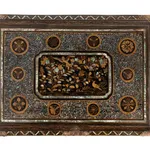
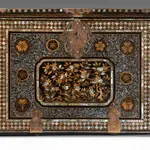
Of rectangular form, the outside decorated in black hiramaki-e lacquer (gold powder sprinkled on a black ground) and inlaid in mother-of-pearl with panels of birds and blossoming branches on a...
Of rectangular form, the outside decorated in black hiramaki-e lacquer (gold powder sprinkled on a black ground) and inlaid in mother-of-pearl with panels of birds and blossoming branches on a mother-of-pearl ground (known as ‘aogai’), within borders of mother-of-pearl triangles and golden wavy lines; the top and front with mon (family emblems); the corners with gilt copper mounts, carrying handles to sides, and an applied gilt copper locking plate to the fall front, opening to reveal the reverse side decorated with kuzu vines and an interior fitted with eight drawers, the central drawer with an architectural-style arch with a lock, each drawer decorated with black lacquer, gilt and inlaid mother-of-pearl chequer board pattern, with gilt floral handles.
This type of cabinet is known as Nanban style, a nickname given to foreigners who arrived ‘from the south’ which translates as 'Southern Barbarian’. It refers to the overseas markets for which these lacquer items were made. They were produced in the late 16th and early 17th centuries for trade with European countries, particularly Portugal (the Portuguese first arrived in the port of Nagasaki in 1543), Spain and the Netherlands. Many were made in Kyoto and their form is inspired by European table cabinets and writing chests. The cost of the materials and the time and skill involved in creating the detailed decoration in such lacquerware meant that it was a very costly product and would have been destined for wealthy customers, often royalty and religious institutions.
According to an entry for the exhibition Japanese Lacquers in the Age of Discovery, December 13, 2016 - January 29, 2017 at Kyoto National Museum, ‘When an object is coated with the sap of the lacquer tree, it becomes extremely tough and durable, resistant to salts, acids, and alcohol. The early Europeans marveled that such lacquerwares could withstand hot water without cracking, and they loved their makie designs made with sprinkled gold powder. Soon makie lacquers had become a popular trade item. In accordance with the tastes of their new Western consumers, makie artists added elements such as inlaid mother-of-pearl and ray skin into their sprinkled gold designs. Some of the shell inlay was influenced by Indian mother-of-pearl techniques, while the ray skin was imported from Siam.’
The decorative designs were not typically Japanese. According to the MET Museum, ‘The leaves and flowers and the geometric borders seen here are not found on contemporaneous works made for use in Japan. It is possible that they demonstrate an awareness of Indian designs transmitted via such trade goods as lacquers and textiles.’ (see MET Museum website entry for accession no. 2015.500.2.29a–k - https://www.metmuseum.org/art/collection/search/40331).
There are a number of close comparators for this table cabinet in museums. See Yale University Art Gallery for an example of similar size, form and decoration (Accession number 2017.61.1a-b); Kyoto National Museum (Museum No. HK59); Suntory Museum of Art for an example decorated with dogs and autumn plants , the Ashmolean Museum (EA1998.17) and an example in the National Trust Collections at Chirk Castle, Wrexham (NT 1170725).
This type of cabinet is known as Nanban style, a nickname given to foreigners who arrived ‘from the south’ which translates as 'Southern Barbarian’. It refers to the overseas markets for which these lacquer items were made. They were produced in the late 16th and early 17th centuries for trade with European countries, particularly Portugal (the Portuguese first arrived in the port of Nagasaki in 1543), Spain and the Netherlands. Many were made in Kyoto and their form is inspired by European table cabinets and writing chests. The cost of the materials and the time and skill involved in creating the detailed decoration in such lacquerware meant that it was a very costly product and would have been destined for wealthy customers, often royalty and religious institutions.
According to an entry for the exhibition Japanese Lacquers in the Age of Discovery, December 13, 2016 - January 29, 2017 at Kyoto National Museum, ‘When an object is coated with the sap of the lacquer tree, it becomes extremely tough and durable, resistant to salts, acids, and alcohol. The early Europeans marveled that such lacquerwares could withstand hot water without cracking, and they loved their makie designs made with sprinkled gold powder. Soon makie lacquers had become a popular trade item. In accordance with the tastes of their new Western consumers, makie artists added elements such as inlaid mother-of-pearl and ray skin into their sprinkled gold designs. Some of the shell inlay was influenced by Indian mother-of-pearl techniques, while the ray skin was imported from Siam.’
The decorative designs were not typically Japanese. According to the MET Museum, ‘The leaves and flowers and the geometric borders seen here are not found on contemporaneous works made for use in Japan. It is possible that they demonstrate an awareness of Indian designs transmitted via such trade goods as lacquers and textiles.’ (see MET Museum website entry for accession no. 2015.500.2.29a–k - https://www.metmuseum.org/art/collection/search/40331).
There are a number of close comparators for this table cabinet in museums. See Yale University Art Gallery for an example of similar size, form and decoration (Accession number 2017.61.1a-b); Kyoto National Museum (Museum No. HK59); Suntory Museum of Art for an example decorated with dogs and autumn plants , the Ashmolean Museum (EA1998.17) and an example in the National Trust Collections at Chirk Castle, Wrexham (NT 1170725).